Friday, January 6, 2023

And then there was covid, and then it was 2023. This may be a momentous moment for Veloprint. Sixteen years ago, when I launched Veloprint, I was still an avid Kansas cyclist, but having retired in the Colorado Rockies I've largely replaced cycling with hiking, and, perhaps emblematically, have sold my gravel bike in order to purchase a lovely tabletop etching press from the Conrad Machine Company. It is pictured here with my beloved Salsa "La Raza" road bike (the same bike that posed for the masthead of Veloprint), which I will never part with as it is my talisman of good times and a reminder of many splendid rides. 


So, after several decades I am experimenting with etching again, but now in the changed environment of "non-toxic" printmaking. I always liked the toxicity of printmaking, but life is good too, so I've opted to try and go solvent free. Here's my first attempt, a scene in the local mountains where someone built a sort of lean-to cum meditation-spot or perhaps an orgone energy gathering platform. I don't really know, but it's a lovely spot.


Friday, January 10, 2020


The interest in the connections between plants and people, referred to in my previous post of seven years ago (!),  culminated in an exhibition in 2018, Big Botany: Conversations with the Plant World, that I am very proud of.  Since that post I have also retired from my wonderful position at the Spencer Museum of Art and now I can talk openly about prints, even the ones I make myself!

Over Thirty years ago, I started a woodcut project inspired by the beautiful fifteenth-century blockbooks known as Biblia Pauperum (Bible of the Poor, a misnomer). These make use of a pictorial scheme that frames narrative images and text in a meaningful relationship, specifically, they comprise a typology that aligns New Testament themes with Old Testament prefigurations. I have seen a number of these rare books in person and their hand-made qualities sing through the deep embossing of the vigorously carved wooden blocks they were printed from. The hand-made paper and inks, which range from sepia to dark brown add to this tactile aesthetic.

I have always found the visual strategy of blockbooks (also "block books"), in which image and text are printed from one block of wood, to be very satisfying, so I had the idea of making an abcedarium (also "abecedarium," an endangered word, alas) for my daughters in a similar format, but not as a blockbook since each page would utilize multiple blocks. My plan was to make an ABC book of edible plants and hand tools, which I thought would provide useful information about important, disappearing knowledge; and this was before the internet had its way with knowledge! My daughters were three, one, and minus five years old at the time so I figured I had time to accomplish this.

My approach was to use one block for the framing motif, an architectural format (recalling the ancient Art of Memory, which also appeared as a blockbook, Ars Memorandi, but that is another story ... ) with windows framing the upper and lower case letters, images of the  appropriate tool and plant, and their names. Each of these was carved on its own block and inserted into the framing block for printing. So, this amounted to six blocks carved for each letter of the alphabet, set into a seventh, the framing block. Not too surprisingly, I was later to publish an article on historical aspects of this this printing strategy, “Modular Prints – A Special Case of the Assembled Woodcut in the 15th- and 16th- Centuries,” in Grand Scale: Monumental Prints in the Age of Dürer and Titian. New Haven: Yale University Press, in association with the Davis Museum and Cultural Center, Wellesley College, 2008: 87-98.


A few years after beginning this project I had only gotten up to the letter “F,” my daughters, now three in number, were growing up, and time for this project was getting harder and harder to find, so the project lay fallow for thirty years until last year when grandchildren inspired me to take it up again. 


Somewhere between 1988 and 2019 the main block (a pine plank) warped and I unthinkingly glued it down onto a piece of plywood to keep it flat. In so doing I created more problems for myself, but more on that later. At this writing I am finishing the letter “Q” and I’m sure that the project will find some kind of conclusion in the course of 2020, though I doubt it will be as originally conceived.


Saturday, November 16, 2013


Last week a group of us from the Spencer Museum of Art were in New York City for Print Week (the photographer, me, is not pictured). 


We had our own trajectories, this is part of mine.


In addition to the IFPDA print fair, I spent time in Chelsea, touching base at Printed Matter, Eyebeam, and several galleries.


I was happy to see that Bitforms included a bicycle in Michel de Broin's installation - it is a bicycle with an exhaust pipe that burps out smoke and comments on the irony of smoking while bicycling (vintage Tour de France videos come to mind).


At the Museum of Art and Design I enjoyed Out of Hand - Materializing the Postdigital with two old friends, one of whom, appropriately it seems, I had not met in person before. A vendor display included a functional 3-D print of Theo Jansen’s walking kinetic sculptures


Two of us had a high altitude meeting with a colleague known for his provocative publications to discuss our Art*Research*Collaboration initiative.


In addition to visits to the New Museum and other well-known art venues I noticed several smaller galleries.


There was time to consider the history of collecting…


and I was able to extend my research into the fascinating story of people and and their connections to plants.


blackwork engraving

subway, Astor Place

bloempjes

Tuesday, August 2, 2011

Looking out the Window at Kansas and Colorado


This is a cross-posting to a set of images I placed on Flickr today - and linked via Flickr:

http://www.flickr.com/photos/steve_goddard/sets/72157627340492428/
[clickable version was not working on blogger]

On July 29, 2011, we drove 626 miles [1005 Kilometers] from our home in Lawrence, Kansas to Estes Park, Colorado. This set is a selection from the 450 photographs I made from the back seat of the car. This started as a test of a new telephoto lens, but very soon it became clear that what I could see from the road was intimately connected to many current concerns and themes, including:

Agribusiness
Cattle and Meat Industries
The Family Farm
Transportation
Advertising
Car Culture
Oil
Natural Gas
Wind
Water
Irrigation
Fundamentalism
Wastelands

Thanks to Larry Stark for inspiration: http://www.larrystark.com/

The photographs have been reduced by about 1/3 of their original size. All were shot through tinted glass at 75 mph so I share them for their content, not their quality.

Sunday, June 26, 2011

Otherworldly


When asked, “how was the trip?” I have been answering, “great!” but it has been difficult to go beyond that because it was not so much a trip as a re-alignment of assumptions. I realized this on my first morning at CICRA while getting dressed, at the moment of loading up my pockets. Wallet? No need. Keys? Nope. Passport? Won’t need that either. Money? No. Cell phone? Definitely not.

The movie that came up the most frequently in our conversations was not Fitzcarraldo, but Alien. This was not only because of our close looking at insects, but also because it is an immersive movie that puts you in another world – a planet named Thedus.

The piece of literature that came to my mind the most often was Ray Bradbury’s 1950 short story, The Long Rain, which I read in my teens nearly 45 years ago but which I remember vividly. The story takes place on Venus and it begins:

"The rain continued. It was a hard rain, a perpetual rain, a sweating and steaming rain; it was mizzle, a downpour, a fountain, a whipping at the eyes, an undertow at the ankles; it was a rain to drown all rains and the memory of rains. It came by the pound and the ton, it hacked at the jungle and cut the trees like scissors and shaved the grass and tunneled the soil and molted the bushes. It shrank men's hands into the hands of wrinkled apes; it rained a solid glassy rain, and it never stopped."

There is an orchid, a variety of Catesetum, in a small container attached to one of the supports for the entry to the dining hall at CICRA. 


I cultivate three varieties of Catasetum at home. When I explain my enthusiasm for orchids, and this genera in particular, I always say, “I like the ones that look like they come from mars – not the ones you can get in the grocery store.” One of my Catasetums has just bloomed, and while here in Lawrence Kansas it looks like it came from Mars, it is at home in the Neotropics.


So, when asked about our time in the rainforest, I say it was great, and then I look for language, metaphores and experiences drawn from otherworldly precedents, like Alien, The Long Rain, and plants from mars.

Sunday, June 19, 2011

Peru Day Twenty - Heading Home [Arriving on Day Twenty-One ??]

On our twentieth day, and our third day waiting to get on a plane home in the wake of the electronic snafu that has crippled our airline carrier, I thought it would be a good moment to post some images of our time together in Peru - What a super-popped group of individuals we assembled from across the University of Kansas! Thanks Bethany, Caroline, Dan, Jeff, Joe, Kelsey, Reed, Riley, Thomas, and Tom; and thanks to our Peruvian colleagues who played such a critical role in the success of this unforgettable trip!


Friday, June 17, 2011

Peru Day Seventeen - Looking Forward & Looking Back

So far the creative components of our trip have included assigned readings, blogging, and some "looking exercizes" involving drawing (thanks to Bethany for offering some practical pointers), watercolor, relief printing, and "sun printing" (a blueprint or cyanotype process -- for a mid-19th-century example see the cyanotype by Anna Atkins in the Spencer Museum of Art, 1997.0033).


Our daily fieldwork and ongoing exposure to new aspects of the rainforest has been all-consuming and often exhausting; therefore we agreed that our primary task while in Peru is to absorb all that we can. The bulk of our individual creative work, and our group project involving K.U. museums, will take form during the summer school session,  upon our return home, so stay tuned for future posts. Some of the potential individual creative projects that we have discussed include a series of short stories, a sculptural rendering of the base of a Cecropia tree, a group of detailed watercolors, and a children's book that would be an ecology primer for use in Peru and elsewhere. Meanwhile, the process of sifting through our hundreds of photographs, notes, and drawings is already serving as a catalyst for this next stage of creative work.


On this, our last day in Peru, I will sign off for now, in deep gratitude for being able to participate in this venture, with a photograph of the rainforest taken from the 60 meter observation tower that overlooks the CICRA/Los Amigos field station (you will have to imagine the sounds of the birds and primates who live in and around the forest canopy).

Peru Day Sixteen -- Gold Mining


Looking back over the past two weeks there are several topics that our group has discussed often but that we have not shared in our blog. One of these concerns our awareness of a bristling tension between ecologists, loggers and gold miners -- all of whom have strong opinions about the natural resources of the Madre de Dios region. This became very clear on our trip up the Rio Madre de Dios toward CICRA when a gold miner mooned us. 

We picked up our boat at Laberinto, a gold mining boom-town, and all along the Rio Madre de Dios one can see the blue tarp and bamboo lean-tos where miners have set up temporary camp while they sift the river silt in hope of finding a way out of poverty.


Since we are guests in Peru we do not presume to enter into the complex political debates that churn around its remarkable rain forests, but it is clear that extensive gold mining is severely polluting the Peru’s rivers with mercury (up to 40,000 tons per year as estimated in 2009, according to the BBC, in turn quoting Peru's environmental ministry).


We did not hear chainsaws from our camp or from our extensive hikes but we have it on good authority that loggers are active not far from CICRA. This was driven home when Thomas and I took a longer-than-usual hike one day and stumbled upon a large tree cut 3/4 the way through but left standing.


Wednesday, June 15, 2011

Peru Day Fifteen -- Catching Insects


Several days ago I came across two primate specialists in the forest. One was wearing a loudspeaker on her head that was emitting monkey calls [calls of the saddle-backed tamarin, I believe]. This got me to thinking about the ways we stretch to get our data, to study animal and plant behavior, to collect specimens, and to document the comings and goings of species. It's hard work that demands a staggering array of equipment from a butterfly net to a portable mass spectrometer. It also requires smart, fit, capable, adaptable people with highly specialized training and lots of imagination. Everyone who contributes to the community at CICRA shares these characteristics -- the permanent staff, the visiting researchers and the students. The sense that just being here is fragile and very special engenders a work ethic in which nothing is wasted; not time, not materials, and not effort. Need ethanol to store you specimens in? It will come over the Andes by truck, then by small boat up the Rio Madre de Dios to be carried by hand up the near vertical ascent from the riverbank to CICRA.
So, back to the loudspeaker-on-the-head thought -- what do the specialists working with our K.U. entomology team use to trap and study insects? I've been keeping track:
Malaise Trap
This is a mesh trap that insects fly into. Once they have hit the mesh they tend to cling onto it and start to climb -- ultimately into a trap. The traps are often jars or pans of water with a little detergent in them to break the surface tension. There are two variations on this theme:

The Terrestrial Malaise trap sits on the ground.


The Canopy Malaise Trap is like a rigid tent that gets raised 20-30 meters up into the forest canopy, it also has a trap to collect insects that that don't grab the mesh but fall after hitting it.


Flight intercept trap
This is similar to a terrestrial malaise trap but it has only a vertical mesh, stretched taught, with pans underneath it to catch flying insects that crash into the mesh and tumble into the pans.


Pan Trap
Another terrestrial trap is the pan trap -- little dishes of water and detergent that are set on the ground or, in the case of the pitfall trap, set into the ground so the lip is level with the ground. The K.U. team uses yellow and blue plastic ware dishes as some insects prefer these colors. Gardener's will recognize the pitfall trap because it is nearly identical to the standard trap for slugs:  a container of beer set into the ground with the lip of the container level with the ground.
Chemical Lure Trap
These are just what they sound like, traps that rely on an insect's interest in certain smells. These need not be fancy pheromones; Reed Niemack of our group has been testing eucalyptus oil, methyl salicylate (wintergreen), vanilla, and Listerine to attract orchid bees. The trap consists of a length of clothesline dipped in one the above solutions and suspended from a branch. The researcher passes by the traps after a set period of time and collects any orchid bees to be had. eucalyptus oil and wintergreen with the big winners.


[photo shows a bumble bee attracted to wintergreen]
Light Traps

Two varieties of light trap have been used by the K.U. team on this research trip – all depend on the “moths around a flame” principle:

Ultraviolet Light Trap - this is sheet draped over a rope with an ultraviolet light shining on it. This attracts all kinds of insects, including (one night) a large rhinoceros beetle.


CDC light trap - These light traps use a narrow UV spectrum and are designed especially for for mosquitoes

Multilure traps
These generally use some combination of scent, bait and light to capture insects, especially flies.
 Mouth Aspirator, aka "pooter" 

This device is essentially a collecting jar with a long rubber tube and a short metal tube coming out of it.  One suck on the rubber tube while aiming the metal tube at a small insect to vacuum it into the bottle. This device was used by Tom Radocy of our group in order to sample the mosquito populations at CICRA (happy birthday, Tom!)


[photo courtesy of Jeff Miller]
Hand Methods
I suppose there is no end of what these might include. On this trip I have seen our team wield the butterfly net, the sweep net, use their cupped hands, and tap insects into small bottles, baggies etc.
I wonder what techniques are used to trap the mass-marketed insect displays from Amazonia that are available in the shops in Lima; and I wonder if the distinction between specimen and trophy has been lost?

Sunday, June 5, 2011

Peru Day Five -- Lima: Layers of Time and Culture


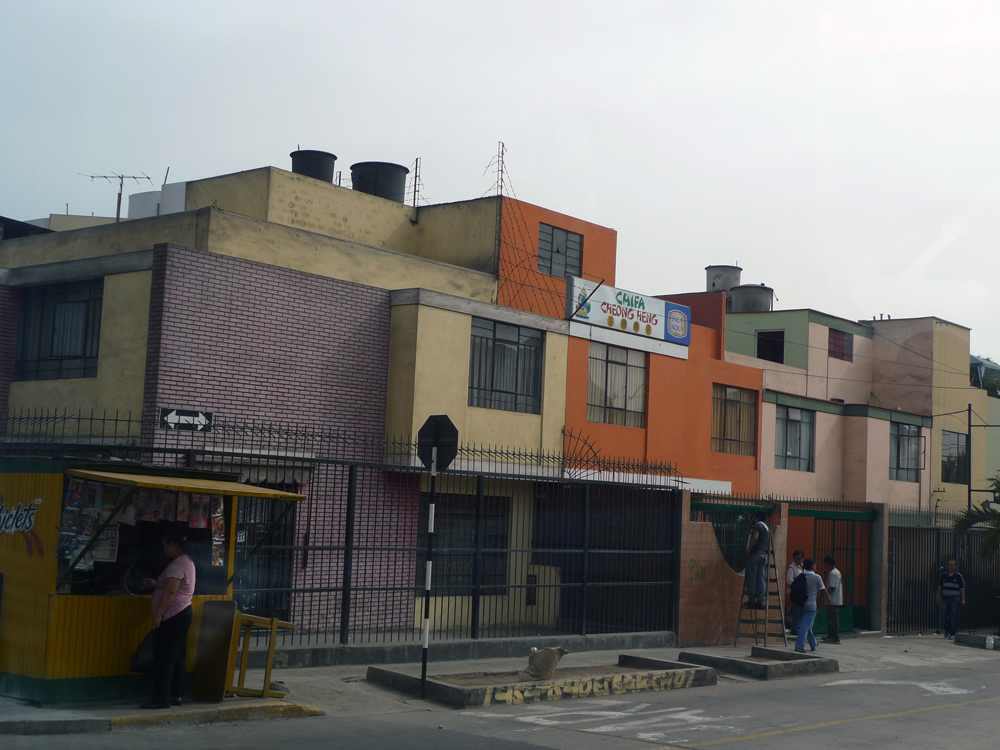
En route to our first stop (Museo de Sito Huallamarca) we passed several chifa, Chinese-Peruvian restaurants, reminders of the large wave of Chinese emigrants who came to Peru in the nineteenth-century to work in sugar plantations and guano mines. I asked our guide, Luis Villacorta (Universidad Católica Sedes Sapientiae), about the etymology of chifa and he suggested that it is a conflation of “rice” and “to eat.”


The scene below, taken from the top of the Huallamarca site, offered a brief moment to reflect on more extended periods of time. In chronological order it shows:

--> Two trees from the genus Araucaria, a “living fossil” that dates back to the early Mesozaic Age (a few hundred million years ago). Most of the surviving species of Araucaria are found in New Guinea, New Caledonia, Australia, Chile and Brazil – all once part of the Gondwana supercontinent.

--> Huallamarca Temple (Hualla Culture, approximately 2000 years ago)

--> Contemporary Lima and some K.U. visitors with Mr. Villacorta


The Museo Arqueológico Rafael Larco Herrera, a marvelous building surrounded by orchids, houses a staggering collection of Peruvian archeological works. A few (including a more recent ornamental carving) that particularly caught my eye:

Breastplate made of Chrysocolla and shell (detail). Formative epoch of the Cupisnique (1250 BCE-1 CE)


Large stone carving of the head of a moon animal. Height of Recuay culture (1 - 800 CE)


 A wood carving with an angelic youth ensconced in a burst of Rococo ornament.