Sunday, June 5, 2011

Peru Day Five -- Lima: Layers of Time and Culture


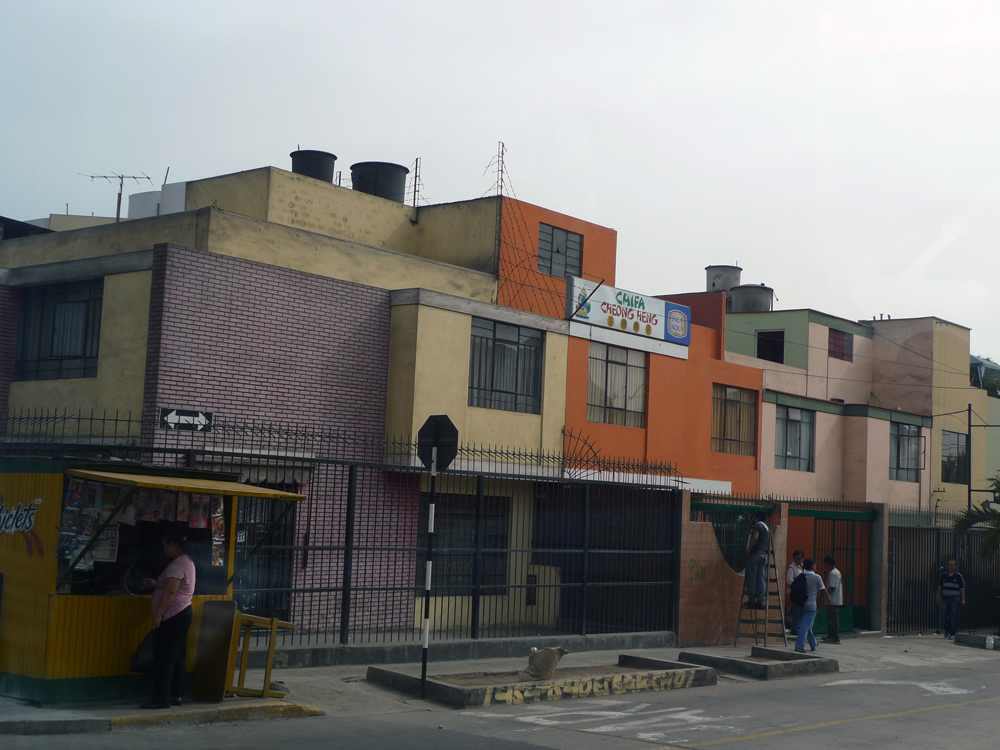
En route to our first stop (Museo de Sito Huallamarca) we passed several chifa, Chinese-Peruvian restaurants, reminders of the large wave of Chinese emigrants who came to Peru in the nineteenth-century to work in sugar plantations and guano mines. I asked our guide, Luis Villacorta (Universidad Católica Sedes Sapientiae), about the etymology of chifa and he suggested that it is a conflation of “rice” and “to eat.”


The scene below, taken from the top of the Huallamarca site, offered a brief moment to reflect on more extended periods of time. In chronological order it shows:

--> Two trees from the genus Araucaria, a “living fossil” that dates back to the early Mesozaic Age (a few hundred million years ago). Most of the surviving species of Araucaria are found in New Guinea, New Caledonia, Australia, Chile and Brazil – all once part of the Gondwana supercontinent.

--> Huallamarca Temple (Hualla Culture, approximately 2000 years ago)

--> Contemporary Lima and some K.U. visitors with Mr. Villacorta


The Museo Arqueológico Rafael Larco Herrera, a marvelous building surrounded by orchids, houses a staggering collection of Peruvian archeological works. A few (including a more recent ornamental carving) that particularly caught my eye:

Breastplate made of Chrysocolla and shell (detail). Formative epoch of the Cupisnique (1250 BCE-1 CE)


Large stone carving of the head of a moon animal. Height of Recuay culture (1 - 800 CE)


 A wood carving with an angelic youth ensconced in a burst of Rococo ornament.

Friday, June 3, 2011

Peru Day Three ~ Preparation day # 3


On this, our final day of preparation, we enjoyed an informative presentation by Dr. Bartholomew Dean (K.U. Anthropology) with discussion about indigenous peoples, current political realities, and practical suggestions for getting around in Peru.

Peru Day Two ~ Preparation day # 2


Today we suited up in our field cloths and meet with Dr. Dean Kettle at the K.U. biological field station for an introduction to field methods. Cicadas had just emerged from their pupae and were seen everywhere drying their wings. We found a giant earthworm, a spider with a captive moth, and a recently hatched snake (probably a black snake).


In the lunch room we learned about entomologists' humor and Super Weevil’s “fight for justice for those with a snout.”


In the afternoon we enjoyed a tour of the K.U. entomology collections led by Dr. Zack Falin, and witnessed several methods of storing collections of insects.

Thursday, June 2, 2011

Peru Day One -- Preparation Day #1

Introduction


Imagine a university course conducted in a Peruvian rainforest. What if you could participate in such an expedition as an undergraduate student? How might this affect your worldview and subsequent trajectory?
Such a course exists at the University of Kansas -- BIOLOGY 418/701 Topics in Field Biology in Amazonian Peru. Thanks to the support of two far-seeing supporters working with the Biodiversity Institute and Spencer Museum of Art at K.U., special provision has been made for BIOLOGY 418/701 to serve as a pilot for an exciting new interdisciplinary program, The Rudkin Undergraduate Scholarships For International Interdisciplinary Research Experiences. The charge of this program has been stated in these terms:
One of the major challenges and opportunities facing the University of Kansas⎯indeed, all universities⎯is providing its undergraduates with a meaningful international and interdisciplinary educational and research experience., i.e., one that integrates disciplines and synthesizes knowledge across the sciences, arts and humanities in a global setting.
The program aspires to, “send teams of three to four undergraduate students from the arts, sciences and other disciplines with the Biodiversity Institute and the Spencer Museum of Art international research expeditions to collaborate, participate in, capture and ‘publish on’ the expedition, integrating and informing their individual perspectives and chosen media.” The outcomes are described more fully:
Publishing: During the expedition, the undergraduates will be provided with the means to “publish” in print, digital and/or other media, e.g., pod casts, weblog journals, reports; photographs; live feed video; newspaper features.
Exhibition: After the expedition, a joint Natural History Museum / Spencer Museum of Art exhibition drawn from these “publications” and other material would be mounted if deemed feasible and appropriate.
BIOLOGY 418/701 Topics in Field Biology in Amazonian Peru is conducted by Dr. Caroline Chaboo, curator and professor in ecology & evolutionary biology (specialist in entomology); and an by artistic advisor, myself, curator of prints and drawings and professor of art history. For the next few weeks this blog will follow the activities of the students in BIOLOGY and will further track the group’s progress toward an exhibition/installation that is expected to open at the Spencer Museum of art in December 2011.

Peru Day One ~ Preparation day # 1


We begin our three days of preparation at the University of Kansas. Today Dr. Chaboo spoke to our group of ten (eight students, two professors) about Insects and insect diversity; about field work and ethical issues surrounding the collection of specimens. We then visited the Spencer Museum of Art where I gave a short tour and shared some works in the print study room, among them:
--> Sebastião Salgado’s – untitled photograph of the Serra Pelada Mine, 1986
--> William Sharp’s 1854 suite of chromolithoraphs with accompanying text, Victoria Regia or the Great Water Lily of America
--> Rodlophe Bresdin’s 1861 biophiliac lithograph Le bon Samaritain (The good Samaratan)
-->H.C. Westermann’s - The Green Hell from The Connecticut Ballroom Suite (1975-76)
--> A drawing by Sophia Gakii from Xu Bing’s Forest Project www.forestproject.net
--> Karl Kröner’s wonderful Waldflechte, an elaboration in gouache of the design forms implicit in a sample of lichen
--> A few buggy sheets from Jacob Hoefnagel’s late sixteenth century Arcetypa studiaque patris Georgii Hoefnagelli
--> Tony Fitzpatrick’s the ten lovely etchings, Bug Circus, of 2001 ((Jewell Bug, Dancing Bug, Lopea, Green Bug, Caterpillar, Grasshopper, Harlequin, Wonder Bug, Ladybug, and Cicada)
* reminder: you can see most of these on the Spencer Museum’s website, use the search field at the upper right of the home page: http://www.spencerart.ku.edu/
We concluded our first day with a tour of the Natural History Museum and a public display, Bug World.


Tuesday, June 17, 2008

Ramifications and Insects

Today was glorious. I spent some time in our research library looking at the first and second editions of Darwin’s On the Origin of Species by Natural Selection to look at the one illustration in the volume, his famous “Tree of Life” diagram showing the natural variation among offspring of a given species, emphasizing those variations that are preserved by natural selection and that lead, after many (thousands) of generations to new genera. This appears in the chapter “Character of Natural Selection” in the section on “Divergence of Character.” Here is some of Darwin’s language on the topic, which I found especially heartening since I am working on a project about trees-as-trees and trees-as-metaphors and I have struggled with the wonderful words “ramify” and “ramification.”
The affinities of all the beings of the same class have sometimes been represented by a great tree. I believe this simile largely speaks the truth. […] As buds give rise by growth to fresh buds, and these, if vigorous, branch out and overtop on all sides many a feebler branch, so by generation I believe it has been with the great Tree of Life, which fills with its dead and broken branches the crust of the earth, and covers the surface with its ever branching and beautiful ramifications.
I also took several hours to look closely at a sumptuously illustrated book by Marie Sibylle de Merian (1647-1717), Histoire générale des insectes de Surinam et de toute l’Europe …. Merian, of the great Frankfurt family of printmakers, begins her text with the disarming admission, "Des ma jeunesse je me suis appliquée à l’examen des Insectes."
Well, a toast to Marie Sibylle for sustaining her childhood love of the study of insects. This book is a beautiful achievement that considers insects in their complex relationships with plants and people. Note the current exhibition at the Getty Museum: Maria Sibylla Merian & Daughters: Women of Art and Science.

[Images courtesy of Wikipedia Commons]

Sunday, May 11, 2008

Litany of Locations of Printy Particulars, Spring 2008

It has been a mad spring, punctuated by an impressive lineup of print-related travels to: Evanston, Northwestern University, Block Gallery, to attend the symposium, “Patterns, Pixels and Process,” held in conjunction with the exhibition Painted by Numbers.
§ →Frieder Nake spoke eloquently, commenting that even forty years ago when you (a computer artist) had only 4K, your mind didn't care, it said, "let's try it, come with me."
§ →Image: © Colette and Jeff Bangert, Large Landscape: Ochre and Black, 1970, ink on paper, computer-plotter (detail)

Wellesley, Davis Museum and Cultural Center, to attend the symposium and opening for Grand Scale: Monumental Prints in the Age of Dürer and Titian.
§ → image: Dürer’s Triumphal Arch of Maximilian was brilliantly installed, allowing it to shine with more than imperial splendor.

B
oston, Museum of Fine Art, to see the exhibition Rhythms of Modern Life: British Prints 1914-1939.

§ → In which the keen edges of British linocuts are seen to churn forth from the froth of WWI (apologies to Edward Wadsworth).


N
ew York, to discuss an idea with a foundation and to visit a collector of prints who is, of course, also a
bicycle fanatic.
§ → In which I learn of the Ghost Bikes.
§ → image: view from a modest hotel room.

New York, MoMA and Parsons/New School, to attend the Mind08 symposium, held in conjunction with the MoMA exhibition, Design and the Elastic Mind (also visiting paper-pilgrim sites such as Printed Matter and the new Kinokuniya bookstore on the Avenue of the Americas).
§ → In which I take thirty pages of notes, many in darkness save blinding flashes from the Blackberry of an idiot sitting next to me.
§ → In which we learn from Peter
Galison of a study by John Nettis and his concern for symmetry in snowflakes (1755), and especially of snowflake No. 84.
§ → image: message received.

C
hicago, to assist in sorting out the estate of two dear friends. By luck I was also able to attend the opening night of Artopolis.

§ → I am captivated by the series, “The Structure of Thought” by Doug and Mike Starn, reminded of the work of Martin Ramirez, and heartened by the presence of artists’ books and printed tee shirts.

§ → image: label copy

M
inneapolis, University of Minnesota, Department of Art, to judge an invitational print exhibition. I Also visit with surprising range of old friends: one from college
days (ca. 1970), one from my years in Belgium (ca. 1980), a previous student (ca. 1990) who is now tenured at “UMN,” and an artist friend who I first met ca. 2000. Happily, I also made at least two new friends and visited Highland press.
§ → image: two UMN studios.


A
s I put pixel to screen I am in South Pasedena, near my home town of Altadena. I am commuting to L.A. to do some research at the Robert Gore Rifkind Center for German Expressionist Studies (LACMA) and to participate in the 7th annual meeting of the Association of Art Museum Curators. I also hope to see two exhibitions: a) concerning Doctrinal Nourishment by my old love, James Ensor, and b) concerning the prints of Ludwig Kirchner.

Wednesday, January 2, 2008

Making Prints in 2008


Well, this will be a short post to encourage all you printmakers out there to make some important work in 2008. I'm still at work on a thank-you print for friends who helped with my travels last fall. I'm just inking up an old test block I made awhile ago to try out various carving tools and, of course, it turned out better than a well-planned image. Best to you all for 2008!